
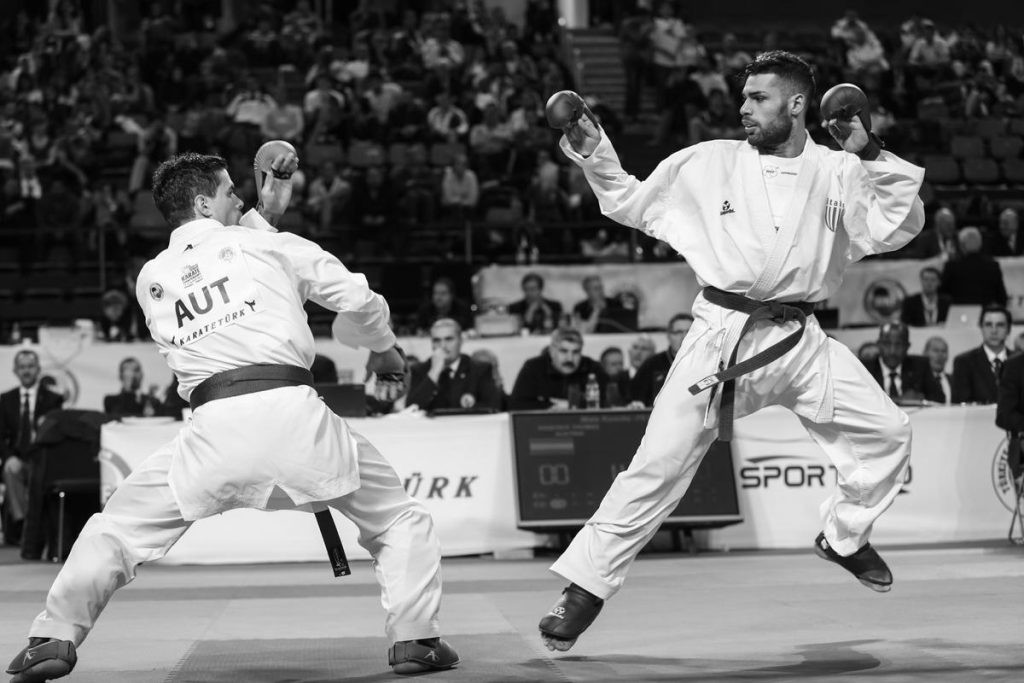
The comparison between martial arts is a complex and widely debated topic. Each discipline has its peculiarities, advantages, and limitations. I decided to analyze Kudo, a modern Japanese martial art, comparing it with other disciplines such as Karate, Judo, Muay Thai, Brazilian Jiu-Jitsu (BJJ), and MMA (Mixed Martial Arts), evaluating their preparation, fighting styles, and practical application both in the ring and in real-life situations, and comparing the biomechanics of sports movements and the intensity of strikes.
Kudo was founded by Takashi Azuma in 1981 in Japan. Originally called “Daido Juku,” it is a form of combat that combines elements of Kyokushin Karate, Judo, and other fighting styles. Azuma created Kudo to offer a complete martial art that could be applied both in competition and self-defense.
KUDO involves intensive training in endurance, strength, and agility. Athletes train in various phases of combat: striking, clinch, standing fight, and ground fighting, improving their versatility.
The mental aspect is very important, emphasizing discipline, control, and situational awareness. Training includes meditation and breathing techniques to improve concentration and stress control.
KARATE incorporates striking techniques, speed, and precision in delivering blows. Physical preparation aims to develop power and agility.
JUDO mainly focuses on throws, joint locks, and ground fighting, and therefore, training is oriented toward endurance and strength.
MUAY THAI, the “art of eight limbs,” focuses on punches, kicks, elbows, and knees. Physical preparation is extremely rigorous, with exercises for endurance and maximal strength.
BJJ’s specialty lies in grappling and ground submissions, and physical training intensifies around strength, endurance, and flexibility.
MMA combines various techniques from different styles such as striking, grappling, and wrestling. Physical preparation is one of the most complete, requiring high levels of strength, endurance, and technical ability.
KUDO relies on multiple striking techniques that enhance its effectiveness, such as mixed striking, punches, kicks, elbows, headbutts, knees, grappling with throws, holds, and submissions.
KUDO uses a characteristic white helmet with a visor to protect the face, allowing head strikes with greater safety for the athlete, and light gloves to enhance the impact of strikes.
The fight lasts continuously for 3 minutes, with few interruptions, favoring a dynamic flow between standing fight and ground fight.
KARATE is conducted with an upright fighting stance, focusing on extremely fast direct strikes alternating punches and kicks.
JUDO demonstrates its effectiveness with holds and throws aimed at bringing the opponent to the ground in submission.
MUAY THAI features a very brutal fight with powerful strikes and clinch work, making it one of the most effective striking styles.
BJJ excels in ground fighting, using joint locks and chokeholds to force the opponent to surrender.
MMA, with techniques of striking, grappling, and wrestling, proves to be an extremely versatile and realistic combat style that fits well in a street context.
KUDO is very effective on the tatami thanks to the combination of striking and grappling techniques, allowing practitioners to adapt to different combat situations.
In real combat, the versatility of KUDO makes it suitable and effective for self-defense. Disarm and control techniques are particularly useful in real-life dangerous situations.
KARATE is effective for self-defense due to the speed and power of strikes but can be limited in grappling situations.
JUDO excels at controlling the opponent and neutralizing close-range attacks, although it may be less effective against long-range strikes.
MUAY THAI is excellent for self-defense due to the power of its strikes and the developed endurance, making it suitable for grappling.
BJJ is ideal for neutralizing an opponent on the ground but may be limited against multiple attackers or in situations where bringing the fight to the ground is difficult.
MMA is complete for self-defense due to the combination of striking, grappling, and controlling the opponent.
No martial art proves to be definitively superior to another in an absolute sense because it depends on personal goals, the context of use, and individual preferences. KUDO stands out for its completeness and versatility, making it suitable for both competition and self-defense. However, it is the martial artist from any discipline who makes the real difference by mastering the skills acquired and knowing how to fully apply them.
For a more in-depth and scientific evaluation, I conclude with a biomechanical comparison of sports movements, comparing the strikes in various martial arts styles.
The biomechanical analysis of techniques and strikes in martial arts helps to better understand how different disciplines use the human body to generate power, efficiency, and control. The technical comparison of striking and grappling in KUDO, KARATE, JUDO, MUAY THAI, BRAZILIAN JIU-JITSU BJJ, and MMA examines factors such as strength, speed, balance, and movement biomechanics.
In KUDO, during mixed striking, the athlete uses trunk and hip rotation to generate power. Body position and the alignment of the arm and leg with the target maximize impact.
Elbow strikes and knee strikes generate force through the contraction of the trunk and leg muscles. Optimal biomechanics require precise alignment to effectively transfer energy from the body’s center to the striking limb. Grappling, with throws and holds, relies on principles of leverage and balance. The correct application of angular and linear forces is essential to unbalance the opponent and gain an immediate advantage. The TANDEN is a specific energy gathering from different muscle sectors that synergistically strengthen the body during dynamic phases. It is a unique feature of the KUDO athlete, with a significant increase in strength during defensive phases.
Submissions involve joint movements and the use of leverage. Effectiveness depends on the precision with which forces are applied to joints and articulations.
Striking in KARATE is based on the use of Zuki (punches), and the biomechanics of the sports movement involve rapid hip and trunk rotation, combined with an explosive contraction of arm muscles.
Kicks (Keri) require perfect coordination between the leg and trunk. Power comes from the rapid extension of the knee and the skilled use of body weight. Knee and elbow strikes are less emphasized than in MUAY THAI but use similar movements with a focus on precision and speed.
JUDO throws (Nage-Waza) exploit body biomechanics to create effective levers. Movements such as the use of the hips (Koshi-Waza) and the use of the legs (Ashi-Waza) require precise balance and optimal force distribution. Ground control (Osae-Waza), thanks to body weight and force distribution, allows the immobilization of the opponent, maximizing contact and pressure.
MUAY THAI uses elbow, kick, and punch striking. The biomechanics are based on generating power through body rotation and the use of body weight. Elbow and knee strikes require explosive muscle contraction and precise body alignment.
Clinching uses pushing and pulling forces to control the opponent. Optimal biomechanics include the use of leverage and control points on the opponent’s body.
Brazilian Jiu-Jitsu (BJJ) makes extensive use of grappling such as submissions, which depend on the biomechanics of joint levers and chokeholds. Precision in the placement of hands and body is crucial to applying the necessary pressure to force a surrender.
Positions require balanced body weight distribution and the use of legs and trunk to maintain control.
Striking combines techniques from various disciplines, emphasizing efficient biomechanics to generate power and speed. Body rotation, balance, and alignment are fundamental.
Grappling integrates techniques from Judo, BJJ, and Wrestling. Biomechanics focus on the use of leverage, balance, and strategically applied force for victory.
The biomechanical analysis of techniques from various martial arts styles highlights how each discipline optimizes the use of the human body to maximize the effectiveness of its techniques. KUDO, with its combination of striking and grappling, stands out for its versatility and full use of the body. Other disciplines, such as MUAY THAI and BJJ, focus respectively on powerful strikes and submission techniques, while KARATE and JUDO, also among the most practiced, emphasize precision and control of one’s body.
Prof. Ph.D Francesco Calarco